Sunday, April 21, 2013

Monday, April 15, 2013
Jewish Alliance of Rhode Island Mission to Cuba April 2013


A sundog (corona eclipse of the sun) over Havana
 At the Guanabacoa Jewish cemetery outside Havana
 At the JDC Pharmacy in the Patronato
 Israeli dancing at the Patronato


Sunday, April 7, 2013
A thought for Yom HaShoah (Holocaust Memorial Day)
One of the most interesting aspects of Jewish Renewal in the former Soviet Union is the focus, in many of the Jewish communities, on the past. A colleague once defined this focus sharply for me. "This," he said, "is a community that defines its present by its past." And the past is most starkly defined by the community's relation to the Shoah (Holocaust).
In community after community, one of the most notable aspects of defining Jewish identity in the FSU is the memorialization of the Shoah. In some respects, Shoah memorialization is one of the strongest definitions of Jewish communal identity. And there's a very good reason for that. For so many years, Jews in the FSU weren't even allowed to recognize their dead publicly. In the rare places where Nazi massacres were commemorated, such as Babi Yar near Kiev, the victims were always seen by the Soviets as "victims of fascism." They were never recognized for what they were, Jews.
With the collapse of the USSR, a massive exploration of the Nazi atrocities was finally allowed to find its public voice.
And for communities that, sixty and seventy years ago, were never allowed to publicly mourn their dead as Jews, the new wave of memorials, lectures, statues and educational efforts are critical .... not just in remembering the past, but in defining their renewed Jewish identity.
Friday, April 5, 2013
Israel's social challenges
I've spent the last few days giving briefings to JDC supporters, specifically on Israel's greatest social challenges. The presentation has to provide people with a framework that's simple enough to be meaningful, but complex enough to provide "answers" on what these challenges contain.
With that in mind, I've tried to focus on three main areas of concern, showing how they impact Israeli society, what their impact has been, and what the Joint is doing about them ....
(1) Poverty. Various indicators show that the OECD poverty rate is about 26%. Israel's is (depending on how you count) 33% ... with demographics such as youth, elderly, Shoah survivors all at that rate of one-third. Some demographics are much, much higher: 58% of Arab-Israelis are under the poverty level. 68% of Ethiopian-Israelis are under the poverty level.
(2) Inequality. Israel's Gini Coefficient (the gap between our richest and poorest) is the widest in the western world. And it's getting wider. And if you thought that the social unrest two years ago, and the Trachtenberg Report, and the election results were the end of the story ... well, to paraphrase Churchill, they weren't even the beginning of the end. They may have been the end of the beginning. Maybe.
(3) Fragmentation. Every modern Western society has perhaps three or four major social cleavages, fissures that divide 'us' from 'them' in our society. Israel has at least 15 - major, significant, wrenching cleavages that disrupt social cohesion and make community-building and civil society more difficult to attain. For example: Left-Right, Center-Periphery, Jews-Arabs, Doves-Hawks, Greenline-Territories, Ashkenazi-Sephardi, Veterans-Immigrants, etc etc. You could probably think of more too.
Once these three issues are framed, we can have a meaningful conversation to have on what we can do and what we are doing.
With that in mind, I've tried to focus on three main areas of concern, showing how they impact Israeli society, what their impact has been, and what the Joint is doing about them ....
(1) Poverty. Various indicators show that the OECD poverty rate is about 26%. Israel's is (depending on how you count) 33% ... with demographics such as youth, elderly, Shoah survivors all at that rate of one-third. Some demographics are much, much higher: 58% of Arab-Israelis are under the poverty level. 68% of Ethiopian-Israelis are under the poverty level.
(2) Inequality. Israel's Gini Coefficient (the gap between our richest and poorest) is the widest in the western world. And it's getting wider. And if you thought that the social unrest two years ago, and the Trachtenberg Report, and the election results were the end of the story ... well, to paraphrase Churchill, they weren't even the beginning of the end. They may have been the end of the beginning. Maybe.
(3) Fragmentation. Every modern Western society has perhaps three or four major social cleavages, fissures that divide 'us' from 'them' in our society. Israel has at least 15 - major, significant, wrenching cleavages that disrupt social cohesion and make community-building and civil society more difficult to attain. For example: Left-Right, Center-Periphery, Jews-Arabs, Doves-Hawks, Greenline-Territories, Ashkenazi-Sephardi, Veterans-Immigrants, etc etc. You could probably think of more too.
Once these three issues are framed, we can have a meaningful conversation to have on what we can do and what we are doing.
Thursday, March 28, 2013
Mornings in Havana are beautiful!
By BEN G. FRANK SPECIAL TO THE JERUSALEM POST
03/09/2013 22:19
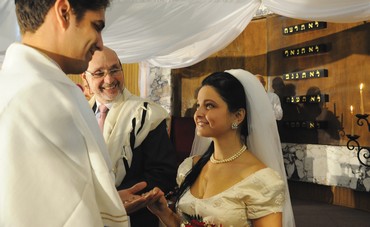
Jewish wedding in Havana Photo: Courtesy JDC
HAVANA – Call it the pearl of the Antilles, the Casablanca of the Caribbean, a tropical paradise.
Lie on its seductive beaches. Fish in its deep bays. Drive around its rolling hills and towering mountains. Meet kind people offering up infectious smiles and romantic Latin music. In size, this island is as large as Florida, where I live, but with its 11 million residents, it is nine million shy of the Sunshine State and only 90 miles from Key West, Florida, a 43-minute flight.
Welcome to Havana, the capital of Cuba, and the largest city in the Caribbean, with over two million residents. Welcome to a city which, although totally run-down, remains a masterpiece of architecture, especially Old Havana with its Spanish colonial structures.
The first thing I do is hasten from the modern Melia Cohiba hotel and walk along the century-old stone wall of the Malecon, Havana’s famous oceanside esplanade. The sea breezes refresh me and the melodic, Spanish chatter of young couples and seniors strolling in the sunshine energizes me. Then, after a long walk, I hop into three-wheel motorcycle “yellow cab,” known as a “Coco Taxi,” and pray it doesn’t break down. My luck, however: it does, but then our driver cranks it up again and we make it back to the hotel.
Because of the 50-year-old American trade embargo, this is the land of the geriatric American car. I found my 1954 Chevrolet on the streets of Havana.
I walk through the Vedado section and later drive through Miramar, and look at the mansions, those stately homes on wide-tree-lined streets, and wonder about the former inhabitants, who left Cuba penniless and had to make their way in a new land.
In the Old Town, I saunter through Havana’s colonial plazas or squares. I sit in a café in the Plaza de La Catedral and absorb the architecture of the colonial era.
This plaza is within walking distance of La Bodeguita del Media, a favorite Ernest Hemingway haunt. I visit all his retreats, constantly hearing: “Hemingway slept here. Hemingway drank here. Hemingway fished here. Hemingway lived here. Hemingway wrote here.”
So I stop at the El Floridita, historic and busy restaurant bar in the old part of Havana, located on Calle Obispo. I visit the Hemingway Museum at Finca la Vigia.
I recall that two great novelists, John Dos Passos and Graham Greene, wrote books here, too.
The harsh realities of Cuban life are ever-present.
If you enter a bodega, you spy half-empty shelves. Although rationing is supposed to be lifted, Cubans still receive ration books that secure staples like rice, beans and oil at low prices. But it’s not enough to live on. My short trip to Cuba proved what I had read and absorbed from other visitors: Cuba itself has literally not progressed physically since January 1959, when Castro took over.
The city’s once-shining buildings are in disrepair, and the country has no money to fix them. I decide that if the US embargo ends and diplomatic relations between the two nations are reestablished, I will go into the paint business; every structure in Cuba needs a fresh coat.
Despite their poor conditions, Cubans carry on. Sidewalks are cracked, potholes huge. Large families live in two rooms; clothes are threadbare. I observe the new self-employed vendors, men and women sitting alongside makeshift displays selling hair accessories or homemade pastries or DVDs.
AFTER FIDEL Castro and his guerrillas took over in 1959, 90 percent of the 14,000 Jewish community fled Cuba. They were not persecuted, were not expelled by force and did not suffer from anti-Semitism.
But since they were involved in trade and business, they fell into the category of enemies of the revolution. Let us not forget that Castro nationalized all business and made Cuba in effect an atheist state.
The tragedy of Cuban Jewry somewhat mirrors the typical Jewish existence in the Diaspora when harsh regimes take over.
Burmese Jews also fled when that country’s army installed a military dictatorship and took over the economy.
While Cuba’s Jews lived a good life pre- Castro, many had come to Cuba with only one desire: to emigrate to the US. For them, Cuba was only a way-station. But because of Washington’s strict immigration policy, many were barred. The tragedy of the 1959 exodus meant these refugees again were uprooted.
Today, approximately 1,100 Jews call Cuba home – all but 300 in Havana, which counts three synagogues: an Orthodox, a Sephardi synagogue and the largest, the Conservative Bet Shalom/El Patronato, located at Calle 1, between 13th and 15th streets in the once upscale Vedado section.
I attend Shabbat services at the Patronato, crowded with Cuban Jews and tourists.
The synagogue has been refurbished, as have the Orthodox Adath Israel at 52 Calle Acosta and Pictota, and the Sephardic synagogue at 17 Calle, between E and F streets, also in Vedado.
Although Cuban Jews live in a police state, Jews can pray openly in a synagogue, learn Hebrew, celebrate Jewish holidays and yes, despite red tape, even emigrate to Israel, although final departure to the Jewish state can take a year or two.
In the early 1960s, 1,500 Jews bore the brunt of Cuban Communist oppression of religion, nearly losing an entire generation under Fidel. I met a man who told me he forgot how to read Hebrew. Jews avoided going to synagogue for fear of damaging their careers in a government that mocked religion. To get ahead required membership in the Communist Party and precluded the active practice of any religion except Marxism. Until 1991, Cuban Jewry meant no rabbi, no mohel, few bar or bat mitzvahs. Many had never witnessed a Jewish wedding.
Everything changed in 1991 when the USSR collapsed. The Cold War ended and with it, the massive Russian political and financial aid that had propped up Castro.
The Soviet Union – Fidel’s banker – was history. With the American trade embargo squeezing the island, Cuba had no choice but to open up slightly.
THE AMERICAN Jewish Joint Distribution Committee (JDC) re-entered Cuba and helped revive the community. Today most of the money to support the synagogues, run the school, provide welfare funds, pay for medicines and cover the costs for the Shabbat meals comes from the JDC, and through the generosity of many Jewish visiting missions to the Jewish community of Cuba. Other organizations also contributed to help Cuban Jewry economically and spiritually including B’nai B’rith, World ORT, Hadassah, Lubavitch of Canada and US federations and synagogues.
Lest we forget, the first Jews to land in the New World were “crypto Jews,” or anusim. On October 27, 1492, Columbus sent converso Luis de Torres ashore in Cuba “to try to learn whether there was any king or cities in that land.”
What Torres discovered, however, was tobacco, which he described as “a firebrand in the hand and herbs to drink the smoke thereof.”
Torres, who knew Hebrew, Aramaic and some Arabic, remained in Cuba as a tobacco planter, becoming the island’s first white resident as well as the Western Hemisphere’s earliest settler of Jewish birth.
Diplomatic relations between the US and Cuba do not exist. Today, Alan Gross, 63, an American Jewish subcontractor for the US government, was jailed in 2009 and later convicted for entering the country as part of a USAID team distributing communications equipment to the island’s Jewish community. Gross was sentenced to 15 years in a Cuban jail. Jewish organizations call for his release on humanitarian grounds.
Cuba is “the forbidden island”– illegal for Americans to travel to unless they latch onto a licensed Jewish Federation, environmental or academic tour group. No such restriction for Israelis. Dr. William Recant, JDC assistant executive vice president, who just returned from Cuba, said he had noticed increasing numbers of Israelis doing business in Cuba, especially in agriculture.
Dr. Recant reported that just this past December, nearly 30 Jewish weddings were conducted in Cuba, by Rabbi Shmuel Szteinhendler of Santiago, Chile, and other rabbis. Rabbi Szteinhendler has made over 100 visits to Cuba since 1992 as part of a mission entrusted to him by the JDC, “to teach, inspire, and conduct religious services and life-cycle celebrations for this resurgent Jewish community.” He summed up the status of Cuban Jews in a few words:“Lejaim. Am Israel b’Cuba hai.”
Ben G. Frank, journalist, travel writer, is the author of the just-published The Scattered Tribe: Traveling the Diaspora from Cuba to India to Tahiti & Beyond, (Globe Pequot Press)
www.bengfrank.blogspot.com
Lie on its seductive beaches. Fish in its deep bays. Drive around its rolling hills and towering mountains. Meet kind people offering up infectious smiles and romantic Latin music. In size, this island is as large as Florida, where I live, but with its 11 million residents, it is nine million shy of the Sunshine State and only 90 miles from Key West, Florida, a 43-minute flight.
Welcome to Havana, the capital of Cuba, and the largest city in the Caribbean, with over two million residents. Welcome to a city which, although totally run-down, remains a masterpiece of architecture, especially Old Havana with its Spanish colonial structures.
The first thing I do is hasten from the modern Melia Cohiba hotel and walk along the century-old stone wall of the Malecon, Havana’s famous oceanside esplanade. The sea breezes refresh me and the melodic, Spanish chatter of young couples and seniors strolling in the sunshine energizes me. Then, after a long walk, I hop into three-wheel motorcycle “yellow cab,” known as a “Coco Taxi,” and pray it doesn’t break down. My luck, however: it does, but then our driver cranks it up again and we make it back to the hotel.
Because of the 50-year-old American trade embargo, this is the land of the geriatric American car. I found my 1954 Chevrolet on the streets of Havana.
I walk through the Vedado section and later drive through Miramar, and look at the mansions, those stately homes on wide-tree-lined streets, and wonder about the former inhabitants, who left Cuba penniless and had to make their way in a new land.
In the Old Town, I saunter through Havana’s colonial plazas or squares. I sit in a café in the Plaza de La Catedral and absorb the architecture of the colonial era.
This plaza is within walking distance of La Bodeguita del Media, a favorite Ernest Hemingway haunt. I visit all his retreats, constantly hearing: “Hemingway slept here. Hemingway drank here. Hemingway fished here. Hemingway lived here. Hemingway wrote here.”
So I stop at the El Floridita, historic and busy restaurant bar in the old part of Havana, located on Calle Obispo. I visit the Hemingway Museum at Finca la Vigia.
I recall that two great novelists, John Dos Passos and Graham Greene, wrote books here, too.
The harsh realities of Cuban life are ever-present.
If you enter a bodega, you spy half-empty shelves. Although rationing is supposed to be lifted, Cubans still receive ration books that secure staples like rice, beans and oil at low prices. But it’s not enough to live on. My short trip to Cuba proved what I had read and absorbed from other visitors: Cuba itself has literally not progressed physically since January 1959, when Castro took over.
The city’s once-shining buildings are in disrepair, and the country has no money to fix them. I decide that if the US embargo ends and diplomatic relations between the two nations are reestablished, I will go into the paint business; every structure in Cuba needs a fresh coat.
Despite their poor conditions, Cubans carry on. Sidewalks are cracked, potholes huge. Large families live in two rooms; clothes are threadbare. I observe the new self-employed vendors, men and women sitting alongside makeshift displays selling hair accessories or homemade pastries or DVDs.
AFTER FIDEL Castro and his guerrillas took over in 1959, 90 percent of the 14,000 Jewish community fled Cuba. They were not persecuted, were not expelled by force and did not suffer from anti-Semitism.
But since they were involved in trade and business, they fell into the category of enemies of the revolution. Let us not forget that Castro nationalized all business and made Cuba in effect an atheist state.
The tragedy of Cuban Jewry somewhat mirrors the typical Jewish existence in the Diaspora when harsh regimes take over.
Burmese Jews also fled when that country’s army installed a military dictatorship and took over the economy.
While Cuba’s Jews lived a good life pre- Castro, many had come to Cuba with only one desire: to emigrate to the US. For them, Cuba was only a way-station. But because of Washington’s strict immigration policy, many were barred. The tragedy of the 1959 exodus meant these refugees again were uprooted.
Today, approximately 1,100 Jews call Cuba home – all but 300 in Havana, which counts three synagogues: an Orthodox, a Sephardi synagogue and the largest, the Conservative Bet Shalom/El Patronato, located at Calle 1, between 13th and 15th streets in the once upscale Vedado section.
I attend Shabbat services at the Patronato, crowded with Cuban Jews and tourists.
The synagogue has been refurbished, as have the Orthodox Adath Israel at 52 Calle Acosta and Pictota, and the Sephardic synagogue at 17 Calle, between E and F streets, also in Vedado.
Although Cuban Jews live in a police state, Jews can pray openly in a synagogue, learn Hebrew, celebrate Jewish holidays and yes, despite red tape, even emigrate to Israel, although final departure to the Jewish state can take a year or two.
In the early 1960s, 1,500 Jews bore the brunt of Cuban Communist oppression of religion, nearly losing an entire generation under Fidel. I met a man who told me he forgot how to read Hebrew. Jews avoided going to synagogue for fear of damaging their careers in a government that mocked religion. To get ahead required membership in the Communist Party and precluded the active practice of any religion except Marxism. Until 1991, Cuban Jewry meant no rabbi, no mohel, few bar or bat mitzvahs. Many had never witnessed a Jewish wedding.
Everything changed in 1991 when the USSR collapsed. The Cold War ended and with it, the massive Russian political and financial aid that had propped up Castro.
The Soviet Union – Fidel’s banker – was history. With the American trade embargo squeezing the island, Cuba had no choice but to open up slightly.
THE AMERICAN Jewish Joint Distribution Committee (JDC) re-entered Cuba and helped revive the community. Today most of the money to support the synagogues, run the school, provide welfare funds, pay for medicines and cover the costs for the Shabbat meals comes from the JDC, and through the generosity of many Jewish visiting missions to the Jewish community of Cuba. Other organizations also contributed to help Cuban Jewry economically and spiritually including B’nai B’rith, World ORT, Hadassah, Lubavitch of Canada and US federations and synagogues.
Lest we forget, the first Jews to land in the New World were “crypto Jews,” or anusim. On October 27, 1492, Columbus sent converso Luis de Torres ashore in Cuba “to try to learn whether there was any king or cities in that land.”
What Torres discovered, however, was tobacco, which he described as “a firebrand in the hand and herbs to drink the smoke thereof.”
Torres, who knew Hebrew, Aramaic and some Arabic, remained in Cuba as a tobacco planter, becoming the island’s first white resident as well as the Western Hemisphere’s earliest settler of Jewish birth.
Diplomatic relations between the US and Cuba do not exist. Today, Alan Gross, 63, an American Jewish subcontractor for the US government, was jailed in 2009 and later convicted for entering the country as part of a USAID team distributing communications equipment to the island’s Jewish community. Gross was sentenced to 15 years in a Cuban jail. Jewish organizations call for his release on humanitarian grounds.
Cuba is “the forbidden island”– illegal for Americans to travel to unless they latch onto a licensed Jewish Federation, environmental or academic tour group. No such restriction for Israelis. Dr. William Recant, JDC assistant executive vice president, who just returned from Cuba, said he had noticed increasing numbers of Israelis doing business in Cuba, especially in agriculture.
Dr. Recant reported that just this past December, nearly 30 Jewish weddings were conducted in Cuba, by Rabbi Shmuel Szteinhendler of Santiago, Chile, and other rabbis. Rabbi Szteinhendler has made over 100 visits to Cuba since 1992 as part of a mission entrusted to him by the JDC, “to teach, inspire, and conduct religious services and life-cycle celebrations for this resurgent Jewish community.” He summed up the status of Cuban Jews in a few words:“Lejaim. Am Israel b’Cuba hai.”
Ben G. Frank, journalist, travel writer, is the author of the just-published The Scattered Tribe: Traveling the Diaspora from Cuba to India to Tahiti & Beyond, (Globe Pequot Press)
www.bengfrank.blogspot.com
Friday, March 22, 2013
Hungary
I spent the last couple of days with my colleague Zsuzsa Fritz,
Director of the Balint Jewish Community Center in Budapest
and the International Szarvas Camp in Hungary .
Like so many in Hungary ,
her family sought to protect her and never told her that she was
Jewish—concerned that she would never be able to advance in communist Hungary
if she was openly Jewish. There were no elements of Jewish life in her home
growing up, though all her family members were Jewish.
Then at age 16, Zsuzsa's father died and at his funeral,
conducted with Jewish traditions, she discovered that she was Jewish. For several months she tried to absorb this
stunning reality.
This was then the last decade before communism's fall and
the Jews of Hungary started to feel more secure as Jews. She joked that her
mother asked her to go find a nice boy at a local Jewish Rabbinical school, and
listening to her, she started attending all kinds of Jewish events, eventually
leading her to a trip to Israel
and a lifetime career in informal Jewish education.
With her exceptional drive and passion for informal Jewish
education, today Zsusza is the Director of the Balint JCC, a focal point for
Jewish life in Budapest .
Today Hungary is home to
120,000 Jews, the largest Jewish community in central Europe .
Her story is the story of Hungary 's Jews, a miraculous
transformation that she passionately shared, first-hand, and which is still
taking place through the support of our partners.
Friday, March 8, 2013
Visit to Hesed Polina – Almaty, Kazakhstan

The
heart of Hesed is the library. There are 15,000 books. As we walk in to the
building, the “Savlanut” choir of older volunteers sings “Shalom Aleichem.” They
practice several times a week, for the past eight years. They appear in concert
all over the Jewish community and the wider city events.
 We
meet with Inessa Chugainoa, the Hesed Director; we visit the elderly in the
We
meet with Inessa Chugainoa, the Hesed Director; we visit the elderly in the
Hesed
has 1500 clients in Almaty; all the work is done by 100 volunteers. As we come
into the main (tiny) hallway, they're busy packing food packages for the
homebound elderly.


 The
literature club has been meeting for 13 years; it’s called “Mishpachat Shalom
Group.” There are four generations represented in the group, they meet every
two weeks.
The
literature club has been meeting for 13 years; it’s called “Mishpachat Shalom
Group.” There are four generations represented in the group, they meet every
two weeks.
Svetlana
(pink, in the center) is the volunteer director of programming.
The
group is reading a Danielle Steel book, “Echoes” about the Shoah; we spend some
time discussing its themes and meanings, what can they learn from it. Svetlana
summarizes the book for us and says how grateful the group is to the author for
writing this story.
We
live longer because of the day center, Svetlana says. Everyone here is from Ukraine , Poland ,
Russia Kazakhstan
 In the
second room there's a photo exhibit run by the youth – with some terrific
photos. Sasha and Nataliya are in charge of the exhibit. Their hobby is
photography and they initiated this idea; they decided to go round taking
photos of the community, because they see the community as their family, then
the idea widened to others in the community, then outside Almaty, then
international to other countries. It’s incredibly inspiring. You talk to these
terrific young women and see the spark of Jewish community continuing.
In the
second room there's a photo exhibit run by the youth – with some terrific
photos. Sasha and Nataliya are in charge of the exhibit. Their hobby is
photography and they initiated this idea; they decided to go round taking
photos of the community, because they see the community as their family, then
the idea widened to others in the community, then outside Almaty, then
international to other countries. It’s incredibly inspiring. You talk to these
terrific young women and see the spark of Jewish community continuing.
In the
Day Center :
Ludmilla (purple shirt with
red hair) greets us, she was born in Dnepropetrovsk
That’s what they did. They built a life here.
Monday, March 4, 2013
Home visit to an elderly client in Almaty, Kazakhstan
Last
month I visited Dina, a Hesed client in Almaty ,
Kazakhstan
Dina,
85, was born in the Semey Region of Kazakhstan
She
suffers from diabetes and has severe mobility problems; she can't leave the
tiny house easily, and walks slowly with a walking-frame. The house is old, and in desperate need of
repairs. She didn’t have running water
or an indoor toilet until last year. It’s freezing cold outside, but her house
is warm – and very welcoming.
This
is her story …
 Dina’s
father, Yoni, was a minor official in the Communist Party. One morning he was
expelled from the party in a purge. “I only learned about it several years
later from my mother. They were afraid to tell me. We went to live with my
uncle Mottel - in Shymkent, south of here. That’s what saved my father, he
moved to Shymkent and we followed. That
was how you survived in those times – the purges of the late ‘30s - you moved
from small place to small place and you stayed quiet.”
Dina’s
father, Yoni, was a minor official in the Communist Party. One morning he was
expelled from the party in a purge. “I only learned about it several years
later from my mother. They were afraid to tell me. We went to live with my
uncle Mottel - in Shymkent, south of here. That’s what saved my father, he
moved to Shymkent and we followed. That
was how you survived in those times – the purges of the late ‘30s - you moved
from small place to small place and you stayed quiet.”
 “My
sister was in kindergarten, I was in second grade. Uncle Mottel disappeared, and
Father would come maybe once or twice a week to see us and bring us food and
supplies. I was 8 and my sister was 6, and we had to deal with our baby sister
– she was eight months old – alone. Just the two of us. Because we had no
adults. But we didn’t succeed and she died. So we had to take her out to the
forests next to Shymkent and we had to bury her by ourselves.”
“My
sister was in kindergarten, I was in second grade. Uncle Mottel disappeared, and
Father would come maybe once or twice a week to see us and bring us food and
supplies. I was 8 and my sister was 6, and we had to deal with our baby sister
– she was eight months old – alone. Just the two of us. Because we had no
adults. But we didn’t succeed and she died. So we had to take her out to the
forests next to Shymkent and we had to bury her by ourselves.”
Dina
starts crying as she tells us the story. Nelly - the wonderful Hesed case
worker in the blue-black print shirt - strokes her hand as she speaks. She
calls Nelly “my gold and diamonds.”
“When
the war started, father went to the army and mother found work sewing army
uniforms. We would sleep – me and my sister – on top of a stove oven, it was
nice and warm. We lived in a communal
building and a shared apartment. There were lots of refugees from the west (of
the Soviet Union, meaning Ukraine
 “I
came to Almaty at age 17 on my own. I was thin and hungry; I was suffering from
malnutrition. Because my father was killed in the war I got special permission
to live in the city of
“I
came to Almaty at age 17 on my own. I was thin and hungry; I was suffering from
malnutrition. Because my father was killed in the war I got special permission
to live in the city of  Dina
was a teacher for 40 years; she’s lived in this small house for 63 years. It has
three families, each with a separate entrance. The house was built in 1918 but the
city authorities have said that they won't repair it since it should be torn
down. The problem is that they won't give her alternative housing. They'd just throw her into the street. So she
stays.
Dina
was a teacher for 40 years; she’s lived in this small house for 63 years. It has
three families, each with a separate entrance. The house was built in 1918 but the
city authorities have said that they won't repair it since it should be torn
down. The problem is that they won't give her alternative housing. They'd just throw her into the street. So she
stays.
When
her grandson was approaching military-draft age, her daughter felt she needed
to take him and leave. “But I never thought about leaving. And I thought my
daughter would return. This is my home. I couldn’t leave. It’s all I know.”
There's
a gas balloon in the kitchen. Nelly asked Dina once why she doesn’t move it
somewhere safer. “Well, it hasn’t exploded for forty years so far, so I’m
good.” She's still frightened to use the new toilet, installed last year – she was
afraid that it might break or crack. This winter was particularly harsh, and
Nelly persuaded her to start using it rather than go outside and use the
outside-toilet.
 “I
always knew I was Jewish. We never really talked about it. At work they kept
reminding me I was Jewish. I hadn’t heard about Hesed. But the school from
where I’d retired did a short movie about education and they asked me to appear
in it. The Hesed people saw me on the movie, the school people said to them,
she's Jewish and she's alone, you should help her - so they came to me and
said, we’re from the mishpocha, we’re from the family, let us help you. I
didn’t have anyone. It was really difficult. But now I have Hesed. Now I have
Nelly. For eighteen years, since my daughter left, I’ve been living here on my
own. Now I have Nelly, so I'm not alone anymore.”
“I
always knew I was Jewish. We never really talked about it. At work they kept
reminding me I was Jewish. I hadn’t heard about Hesed. But the school from
where I’d retired did a short movie about education and they asked me to appear
in it. The Hesed people saw me on the movie, the school people said to them,
she's Jewish and she's alone, you should help her - so they came to me and
said, we’re from the mishpocha, we’re from the family, let us help you. I
didn’t have anyone. It was really difficult. But now I have Hesed. Now I have
Nelly. For eighteen years, since my daughter left, I’ve been living here on my
own. Now I have Nelly, so I'm not alone anymore.” 
Because
of the assistance of our federations and donors, Hesed is able to give her 12
hours per week of homecare, a monthly food basket, her medications, an electric
heater, and regular home supplies. We’ve done some home repairs as well.
As we
leave she's crying again: “thank you for coming, thank you for helping. We need
to take care of each other.”
But
this is a different kind of crying from when we arrived. When she started
speaking, she was crying from sadness. But when we left she was crying from
happiness.
Monday, February 25, 2013
An update from Dr. Rick Hodes, JDC-Ethiopia


Perhaps he's closer to the truth - many will need traction before surgery.
Patient details to follow!
All my best,
Rick and the JDC-Ethiopia team
Subscribe to:
Posts (Atom)