Showing posts with label Elderly. Show all posts

Monday, July 14, 2014

Transitions - stuff I'm taking

I'm clearing out my desk and shelves from the collected memorabilia of nine years in the Joint. And there's a growing pile of things I'm taking with me:

1. My cigar-box covers from Cuba. So the story is ... you can't really "buy" empty cigar boxes in Cuba anymore, because the government is afraid of counterfeiters getting good boxes and putting bad cigars in them. But the artwork is beautiful. And having staffed over 20 missions to Cuba I picked up some lovely art; the cigar-box covers are my favorites. Incidentally, did you know why some cigars have the names of famous works of literature? Because cigar-rollers were illiterate, and they would have the news, stories - and great books - read to them at times. Hence "Romeo and Juliet" and [The Count of] "Montecristo."

2. My Kassam rose. Created by a terrific Israeli artist, Yaron Bob, who was helped by JDC to set up his business. Yaron turns the pieces of kassam rockets that fall onto Sderot into beautiful metal rose sculptures. It is literally turning the worst things you can imagine into works of art and beauty.


3. A bottle of "Red Moscow" (Kraznaya Moskva) Perfume.  I kept going into the homes of elderly women in former Soviet republics and smelling the same spicy floral fragrance. After a while I figured out what it was, and then I learned that pretty much everyone smells that way because that was pretty much the only perfume you could buy for much of the Soviet era. So everyone's mom, grandma, neighbor, smelled like Red Moscow. 
And because the alcohol content is so high ... well ... we'll leave that story for another blog post.

4. A nametag from a JDC educational conference in Vilnius, Lithuania. There were 1000 participants at this conference - a local Limmud - and JDC was helping to put it together. The conference was in English, Hebrew, Yiddish, Russian, Lithuanian, with a massive array of subjects. Israeli history, Lithuanian Jewish history, Jewish gastronomy, culture, the weekly parasha, public speaking, fundraising, you name it. It was an amazing experience, and a privilege to see the rebirth of Jewish life in Vilnius. 


Tuesday, June 3, 2014

How not to be alone

Etti is 94 years old. She lives with a caregiver in Bet HaKerem, in Jerusalem. And she's a member of a JDC Supportive Community. I met her recently when she was doing some group exercises in the Supportive Community program (below). The elderly meet every day for a cultural program, maybe a meal or a movie, or a lecture about something interesting.

The Community Father, Tzion, is JDC's liaison to the 240 elderly clients in the community. They receive cultural activities, medical support, emergency care if needed, home repairs ... most of all, they get the knowledge that they're not alone. That people care about them.

This is the key to ageing-in-place - we know that people live longer when they live at home. But they have to have a decent life, and a social framework, as well as the care and medical support they need.

There are 250 Supportive Communities all over Israel, serving some 50,000 Jews, Arabs, Haredim, blind, disabled, minorities ... you name it.

And sitting in Etti's living room later, we talked with Tzion and Rachel (the Community "Mother," who organizes cultural and other programs). Tzion worked 36 years in the Bezek phone company. "In 36 years I never once had a single day as good as every day I have here as the Community Father."

And for Etti, who sometimes needs Tzion to change a lightbulb, or help her when she feels sick or weak, Tzion is "really like my Father. He's there for me. I'm not alone."


If you want to receive this blog on a regular basis by email, sign up in the top-right box where it says "follow" ...

Saturday, May 24, 2014

Poor Mermaids

We were in Bat-Yam* the other day learning about issues of poverty. My colleague Jack Habib from Myers-JDC-Brookdale gave a fascinating overview about poverty in Israel.

Bat-Yam has a massively disproportionate level of poverty. So it was an appropriate location to discuss poverty rates and what they mean.

Israel has the highest poverty rate in the West - 25% (1.8m). 36% of all children (860,000) live under the poverty level.

But here's the really fascinating bit: poverty rates differ among different population groups. So 54% of Haredim (Ultra-Orthodox) and 54% of Arab-Israelis are poor. But 39% of Ethiopian-Israelis and 19% of the elderly are classed that way. Among non-Haredi Jews, only 12% are under the poverty line.

So .... the continued growth of Haredim and Arab-Israelis as a percentage of the population, by definition, is going to increase poverty rates in Israel unless we change their employment rates and earnings capacity. It's going to be a national priority. And a Zionist one.


*"Mermaid", or "Daughter of the Sea," or "Daughter of Jerusalem." Depends on which local you believe.

Wednesday, April 30, 2014

How much stuff costs

I had a conversation with a colleague the other day from a nearby Jewish federation about "how much things cost" for JDC services around the world.

Bearing in mind that costs differ from community to community, and equivalencies aren't as simple as you'd hope ... here nonetheless are some basic illustrative 'unit costs' that give you a good sense of the kind of tzedaka (charity) opportunities you can have when you make a donation.

$180 sends an Israeli with a disability to an independent living skills workshop, like computer skills, healthy living, household management.

$300 send an at-risk Israeli kid to a business entrepeneurship program, helping ease his or her transition into society and keeping them safe and off the streets.

$1000 sends one kid to the Szarvas summer camp in Hungary, changing lives and renewing Jewish community across Europe.

$1750 can cover the cost of an elderly client with food, medicine, home care and winter relief in the former Soviet Union.

$2150 can allow an Israeli woman to take part in a 'Woman of Valor' Employment program, shifting her from economic dependence to independence, and changing the face of Israeli society.

If you're looking for a way to make a difference - a real, powerful, personal difference - in one person's life, consider these ideas when you go to make a gift.
And if you've already made that gift, directly to the Joint or through your federation, then know how grateful we are - on behalf of the people above, and all those whose lives you've enriched, empowered and rescued.


Monday, April 7, 2014

Teens

I love meeting with teen groups. You can spend time with a Jewish federation teen philanthropy group and come out feeling optimistic about the future of Jewish community leadership.

Yesterday I presented some programs to the “Jteam” teen philanthropy initiative at the Jewish Federation of Greater Middlesex County in NJ. 
Programs like “Better Together” in Ashkelon, working to empower the weakest and most vulnerable populations. At-risk children, weaker immigrants, difficult socioeconomic backgrounds. Programs like the Elderly Food Program for Jews in the former Soviet Union, saving tens of thousands of lives every day.

But … here’s the catch. Would we continue these programs without the teens’ funding? Absolutely. So why are we asking?

For two reasons.

First … because every dollar makes an impact. A one thousand dollar donation, on average, can save one elderly Jew in the former Soviet Union. Enough extra food, medicine and homecare to give life for a year. So the lesson that saving one life is like saving the entire world really has meaning.

But second – and just as important – because conversations with teen philanthropy groups aren't just about the vulnerable, the poor, the weak at all. They’re about us.

They’re about the future of our Jewish communities, how we think about philanthropy and continuity.

They’re about the kind of leadership we want to see in twenty years time … and how we prepare them today.


Thursday, March 13, 2014

Wars of nations are fought to change maps. But wars of poverty are fought to map change

I was giving a briefing last night here in Boston on the situation in Ukraine and, specifically, on the increased costs of our operations there. If we have to keep Hesed case workers longer hours, have them sleep over in the homes of immobile clients and increase security ... these items add to the budget. But more importantly, there's a huge issue of food costs that's looming for our Hesed programs and our clients.

As inflation, hoarding and shortages hits the food supply, we've noticed a 15-30% increase in the cost of basic food items in the past couple of weeks. The problem is that if you're a Jewish pensioner living in Ukraine, then your pension barely covers the minimal amount you were buying beforehand. As it was, you've been forced to make horrible choices between food and medicine, or limit the amount of decent produce you could buy. But now ... even a slight fluctuation in food costs will make life impossible.

Explaining this with stories is important. But there's a clear visual image that brings this home:


Even before this latest crisis, the state-run social services haven't been adjusted to keep pace with the deteriorating local economies. So you saw rising costs, growing unemployment, and ongoing currency fluctuations. If you're living in Ukraine, or Russia, or many of the countries in which we serve - you won't earn enough in your pension to cover even your basic expenses.

Want to know why life expectancy in these countries is so short, and why health is so poor? Start with that chart.

Want to know how to make a difference? Help us help the poorest, neediest Jews in the world through your Jewish federation or with a direct donation.


(The quote is by Muhammed Ali)


Sunday, March 2, 2014

I live like a flower

Sometimes, when I’m looking for inspiration, I look through notes from meeting Hesed clients – elderly Jewish survivors and community members who rely on our donors and federations for their food, medicine and homecare. Without the support of our donors and our Jewish federations, these elderly Jews wouldn't be alive.

And this weekend I came across the story of Ida, in Vilnius, Lithuania, whom I met last year. Our car got lost on our way to her in a labyrinth of Khruschevkyas, badly-numbered and randomly-ordered massive Soviet-era buildings. It was difficult to drive through because the spaces between the buildings weren't designed with the idea that people would have private cars parked nearby.

Ida lives on the fourth floor. She hasn't left the apartment since January 2007. She was in her kitchen carrying coffee grinds and she slipped. She broke her hip and since then she stays inside. Once a year a family friend takes her to the cemetery to see her son’s grave. Her Husband died in 2007, a few weeks after her son. Her sister in 1984, her mother in 1986. Her dog died in 2008.

But she is still living. We bring her food, winter relief, a social case worker, and the knowledge that she’s not alone.

Ida was born in 1924 in Gomel, Belorussia so she’s now 90 years old. She’s full of life, with a beaming smile and more energy than her visitors.

 “Oy Joint” she says with a beautiful smile. “I remember the Joint. In 1944 in the war my mother and sister and me came to Gomel and the Joint gave us help. They gave us cans of fish and meat and clothes. I want to share a story. I got a skirt from the Joint. It was black and beautiful with short sleeves and this skirt was very short (she giggles). It was called ‘the man doesn't have time.’ It was slit down the side.” (Yes, I was blushing. No, she wasn't).

“Later when I came to Vilnius I got four JDC packages – clothing, winter clothes. Thank you."

“Why do I live so long? Because God loves me. I live like a flower. I open up slowly and I have a beautiful fragrance that surrounds me. And now the Jewish community is my family, and they take care of me.”


Wednesday, January 8, 2014

Yet another reason why I love my job

I spent an hour this morning visiting one of the most amazing Jewish women in Budapest. 

Erzabet (Elizabeth) is 90 and was one of the Shoah survivors saved by the Swedish diplomat Raoul Wallenberg. She was caught several times by the Arrow Cross (the Nazi-backed Hungarian fascists) and the Nazis, but each time managed to escape. "They kept capturing me, so I kept escaping, " she said.

And she was telling us about the food packages she received from the Joint.... and suddenly we realized that she wasn't talking about the food packages she receives now, but rather the ones she received from us in the 1940s, with her first coat, and the taste of chocolate.

Tuesday, November 19, 2013

Lots of places ... or just a few

I’m in Connecticut for the next couple of days, meeting federations and supporters of our work. One aspect, in particular, keeps coming back as a theme in my meetings, and I wanted to write a few thoughts about it now.

It’s this issue of the elderly in the former Soviet countries. We work in some 2800 locations, across 11 time zones (don’t get me started … I’ve been down that road before) and in many of the locations there are elderly Jewish clients dispersed to the far winds. 
Wouldn't it be so much easier – I often get asked – if we centralize the clients in large urban areas?

On the face of it, this is a really good, and obvious question. 
And especially when you think about two factors that are worth considering:

(1)    The Joint is a leading agent for ageing-in-place programs in places like Israel (such as “supportive communities,” which we call Naturally Occurring Retirement Communities” or NORCs, in the US)

(2)    The trend of Jewish life is to consolidation and urbanization (lots more on this in some future post).

And yet … there are (at least) three reasons why we’re not going to see any centralization of elderly clients to receive the life-saving food, medicine and homecare provisions that we give in the former Soviet Union:

(1)    From a demographic perspective … all those who would have moved, already moved. Most of them left, in the late 80s and early 90s. Those who are now elderly in their apartments don’t want to move anywhere. Forcing them to move isn't something we can feasibly or morally do.
(2)    From an economic perspective … building old-age homes is an astronomically expensive proposition in former Soviet countries. It would destroy our budgets and we’d need to create a whole infrastructure around these homes that doesn't currently exist.
(3)    From a psychological perspective … the idea of an old-age home in the former Soviet Union is a terrifying prospect for an elderly person. It conjures up all kinds of horrible institutionalized Soviet memories of times past.

I’m not saying it won’t happen. I’m certainly not saying it can’t happen. But if you've got the desire to make a massive impact on the lives of elderly Jews in the former Soviet Union, the best bang for your charitable buck right now is the Hesed system and its incredible life-saving work.

And if you haven’t yet climbed the five flights of stairs in a crumbling Khrushchyovka building, held hands with an elderly client whose life is saved because of the generosity and kindness of our supporters …  come with us on a mission soon, and see what we mean when we talk about saving one life is like saving the entire world.


Monday, July 22, 2013

Keep taking the pills

Yossi, a doctor in Jerusalem, wrote a prescription for his mother.

She thought he had mixed it up because he had given her a generic medicine. There's no difference at all between them but she looked at the color, shape, saw that they were different – how could they be the same?
So she stopped taking them for a while.

After he explained the difference, she agreed to take them. But what happens if your son isn’t a doctor, and he writes you a prescription? You may think you were cheated, or someone made a mistake, and just not take the medicines.

I had a fascinating meeting at Hadassah hospital recently to learn about a new program for the elderly in Israel that deals with exactly this issue.

Lots of Israel’s seniors receive more than one kind of prescription medication, so you have a high risk of drug interactions, mix-ups, and potential side effects. So JDC-Eshel teamed up with Hadassah Medical Center to create The Center for Medication Safety for the Elderly

The Center is staffed by clinical pharmacology specialists and clinical pharmacists, who answer the medication-related questions of the elderly and review their medications. The aim is to prevent potential dangers, free of charge.  They’ve answered thousands of queries since the program was launched in 2008, in Hebrew and in Russian.

To give you an idea of the challenges … 78% of the callers take 6-10 medicines, and 19% take 11-15 medicines!

The problem is that, usually, every doctor only looks from his or her own perspective of what specific ailment needs to be treated. So the doctor writes down what she sees and only treats the finger, not the whole body.
Older patients can get nervous about these kinds of things. Sometimes there are conflicting medicines, sometimes older patients make their own decisions on what to take and what not to take, on the basis of really unreliable sources. Some may use the internet, but there's a lot of really useless stuff out there (present blog excluded, right fellas?).  The brochure that comes with the medicine is usually intimidating legalese, too.

So there's a problem with the reliability of information. There’s a problem with time and effort, too. A doctor usually has maybe five minutes to spend on a patient, including small-talk, the actual examination, and writing out the prescription. Who has the time to explain?
And how do you reconcile the different medicines once you’ve left the clinic or you're out of the hospital? You should ask the pharmacist, but there are twenty people standing in line behind you, and the pharmacist needs to sell things to everyone. No one has time.

So .. if the patient knows what the medicine is, what the side-effects are and what the interaction is, then (s)he may be compliant.
But the patient isn’t a mouth through which medicines are given, s/he has to be part of the process, otherwise we won't succeed. A patient will take medicines successfully because she understands why, and is part of the process.

So how do we help?

We developed a model to provide information – not instructions – for the patient, that’s personalized and specific. The phone responders help all those who call (it also works by internet, fax, mail and more). 60% of the calls are connected to hypertension, a large percentage of the rest involve diabetes, osteoporosis, hypothyroidism and more.

This program is a step in the right direction.

We’ve achieved a lot, the service is free and designed for 70+ year-olds, though has helped those younger too. They get 2000-2500 calls a year and could easily expand to get more. That means over 9,000 elderly Israelis whose lives have been improved – and some saved – by answering their questions, treating them with respect and helping them with information.

This is a hugely neglected population. And this is a very treatable disease.


Monday, July 1, 2013

Brain Spa

This was a really moving visit.

How do we prevent or delay cognitive impairment?
It turns out that almost a fifth of elderly Israelis (65+) suffer from cognitive impairment and dementia.  Since our brains are flexible and we can learn new skills, (well, you know, so they tell me), you can treat people and prevent further deterioration.

I went to see how we can help elderly Israelis suffering from cognitive deterioration. JDC-ESHEL has a workshop teaching new skills and exercises to stimulate the brain, enhance cognition and improve memory. 

"Brain Spa" is at ten day care centers for the elderly.
The staff from each center take part in a 40 hour training course to become program facilitators, and they lead weekly workshops over the course of nine months involving discussions, imagination, movement, coordination and the use of computers for exercises. Participants’ cognitive functioning is evaluated before and after completion of the program.

The average age in Shilo HaCarmel Elderly Day Center in Haifa, a longstanding JDC partner, is 85. There are some 100 participants who come for a full day of activities, and Brain Spa is the JDC-Eshel program we’re launching there. It’s part computer-program and part therapy group. I went to the therapy group to chat with the participants.

I’m sitting in a quiet relaxed room with seven lovely women.

We’re doing some deep-breathing and relaxation exercises, a bit of meditation with our eyes closed, and the madricha (counselor) has some (very) relaxing music in the background. 
We go all over the body, relaxing muscles.

When we’re back together and awake (who nodded off? I'm proud to report that I stayed awake, comfortable though it was) we have a chat with the ladies.

Everyone laughs when I start talking to them in Hebrew (they were expecting an American visitor but didn’t know I’m from Israel too). Photographs of small children are passed around, my marital status is discussed, and my "elegant" Hebrew intonation and vocabulary are praised and corrected at the same time.

And then we go round and talk about what we thought about when we were meditating. Rachel, who’s sitting across from me, tells the group that last week she fell at home, had to go to hospital. “I was in pain and they put me on a stretcher there. My feet were cold. The stretcher-bearer spoke all the time in Arabic and ignored me, so at one point I said to him, chamud (sweetie), can you help me with my shoes. It’s the first time in seventy years that I've said ‘kondara’ (shoes) … I've forgotten that word since I was a little girl. But I remembered the word this week.”

All this led to a conversation about remembering things, our short-term and long-term memories.  We go around the table talking about how we remember some things and not others. Chana remembers as a little girl - eighty years ago - going down to Eilat and diving into the sea from the bridge – what colorful fish there were there. And how we threw them some bread.

With age, long-term memory strengthens.

We do a round of remembering names and faces. This is increasingly difficult but really important. The madricha takes out a foam ball, they’re all laughing as they throw the ball (roll it) to each other. Then you have to say the name of the person you’re rolling to. And so on.

By the age of 75, half of the elderly suffer from some form of cognitive impairment. 
These kind of groups are really critical.


Sunday, June 16, 2013

Three Minute Primer on Jewish Elderly in the former Soviet Union

A colleague from a Jewish federation asked me the other day about the elderly Jews in the former Soviet Union, how we got to where we are, and what the needs are going to look like in the coming years. All in three minutes ...

So here's the basic idea (and I'll try to do some more down the line):

As the caseload has aged (thanks to the help the elderly get from Hesed), their needs have changed ... they are less mobile, more sickly, and more isolated.  

Given the fact that there is virtually no institutional care, these clients become home-bound, without the resources needed to care for them
-no one to cook
-no one to clean
-no one to shop
-no one to pick up their medicines, etc.

On the scale of need - these people really are at the top.  So, as we have done from the onset of our re-entry in to the FSU, we have made the program sensitive to the greatest needs of those who depend on us. 

To give it broader context, we started out in the early 90's with food distribution as the primary function of Hesed.

As medicines became harder to secure, we added them to the mix, recognizing that from a limited pension, food and medicine were the two most expensive and critical items. 

About six years ago we graduated into food cards, which allowed the elderly to choose their individual mix of food and medicine by using the equivalent of a debit card, based on arrangements with supermarket and pharmacy chains, where possible.  

And about three years ago we started putting more of an emphasis on homecare, because this was emerging as the primary need.  

There is still, of course, a food/medicine distribution program, and food cards where these are available.  But the growth area is in homecare so that we can respond to the needs of the most vulnerable, especially in the former Soviet Union. And it's the support of our Jewish federations and donors that allow us to reach out to these most vulnerable, in several thousand locations, on a daily basis, to bring them food, medicine and homecare.

We try to find as many opportunities as possible to say thank you. But if you're reading this, and you're one of those generous donors, or federation donors, then you should know how grateful we, and the clients whose lives you're saving, really are.

If you want to receive this blog on a regular basis by email (about twice a week, depending on what else I'm up to), sign up in the top-right box where it says "follow" ...

Tuesday, May 21, 2013

Difficult steps


Today I met with Lena, a 78-year old client of our Hesed (welfare) system. She never married and has no children.

She is entirely dependent on JDC for everything – for her food, for her medicine, for her home care … even for her entire contact with the outside world. 
And meeting her was one of the most memorable and important encounters I’ve had in a long time.

Lena was born in Nikolaev, about two hours away from Odessa, in 1935.
She remembers the smell of gefilte fish and the taste of apple strudel on Shabbat as a little girl.

She remembers the arguments in her family, as the Nazis invaded, about whether to stay or to flee.
Her parents chose to be evacuated, and spent several years in Central Asia with her uncle, a former Enemy of the People, who was in internal exile. Everyone else in her family – all the other uncles, aunts, cousins, grandparents – decided that the Germans would live up to their civilized tradition, and would almost certainly be no worse than the Soviets.

They stayed and were killed.
Every single member of her family except for Lena, her uncle and her parents, were killed by the Nazis.

Years later, Lena went back to Nikolaev and asked about her Grandfather, with whom she had a close relationship. All the neighbors remembered him, she said.
They remembered him because on that day in September 1941 when the Nazis rounded up all the Jews to the central square, he couldn’t walk.
So they put him in a wagon. And then they marched them all off and no one saw the Jews of Nikolaev again.

Lena settled in Odessa. She couldn’t imagine returning to Nikolaev. She worked as an engineer for a research institute until she retired in 1989.
And since 1999 she's been helped by Hesed. She has heart disease, hypertension, diabetes, a hip fracture. And in an economy like Ukraine’s today, with no Medicaid or Medicare, if you have a broken hip and serious medical ailments – well, you won't be able to afford decent medical care anyway, and your better choice is to stay at home and die slowly with some dignity than go to a terrible, awful, dangerous hospital and die very fast in a corridor with no sheets and no one to look after you.

Lena’s pension is about $150 a month. After paying for utilities and medicines, she has almost nothing left for food, let alone anything else. That’s one of the reasons why life expectancy is so short in a place like Ukraine (high 50s for a man, low 60s for a woman) – you can't afford to live longer, with the medicines and decent food that would keep you alive. So we help with a home care worker, who visits twice a day. We help with a food card, and medical support, and home repairs, and a walker, and more.

But Lena can't use the food card herself. So her case worker takes her shopping list and the JDC Food Card, and does the shopping for her.
Lena hasn’t left her apartment for nine years. The steps are too difficult.
There is a tiny step in her one bedroom apartment … it leads to a small balcony. Lena hasn’t been on that balcony either for nine years. It would be too dangerous.

But she is alive, and she has dignity, and guests come to visit her every day.
“Thank God for Hesed,” she told us. “Thank God it exists for us. Spasiba Bolshoya – thank you so much.”


Friday, May 10, 2013

Health challenges in the FSU


There was a fascinating discussion at the JDC Board meetings the other day about the health of the elderly.

The general feeling, expressed by one of my colleagues, is that we should be proud of what we've done, and concerned that we’re not doing enough.

There are huge challenges. The first seems to be the massive amount of change that is coming up on the horizon. The needs are going to change as the elderly age through the system, meaning that their needs are going to get more expensive. This is already well-know and we can see the implications already in our planning and infrastructure: a 65 year-old’s package of services is heavily tilted in favor of food. A 75-year old’s package of services is increasingly medicine-heavy (and medicine is much more expensive than food). An 85-year old is more reliant on home care (which is more expensive than medicine, by far). 
And so on.

Second is the willingness of governments to let NGOs come in and do the work. If we want to help the elderly live the kind of lives we live, and expect to have in the US, we’re going to have to provide unimaginable levels of support, and that will require massive cooperation with governments.

And third is the issue of loneliness. So many of our clients are homebound and lonely. We not only have to provide them with food, medicine, and homecare. 

We have to give them hope and dignity and a sense of belonging. 

Thursday, May 9, 2013

Celebrating grandpa's bar mitzvah

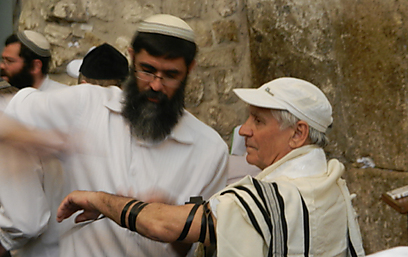
(There was a wonderful moment last week, escorting an inspiring group on a JDC Strategic Partnership mission, visiting the Kotel and learning about JDC-Israel's work with the elderly and Shoah survivors, to read this article ...)


Celebrating grandpa's bar mitzvah

Forty Holocaust survivors, who never got to celebrate their coming of age properly, hold moving ceremony with families at Western Wall plaza. 'After 70 years, I dedicate this day to my mother and father who fought for me,' one of them says
Omri Efraim
Published: 05.04.13, 09:12 / Israel Jewish Scene


It has already become a tradition:
 Dozens of Holocaust survivors, who were robbed of their childhood and never got to mark their coming of age properly, finally fulfill their dream at the Western Wall in a late bar mitzvah celebration.

Some 40 Holocaust survivors, who turned 13 during World War II, arrived at the Western Wall plaza on Monday for a tefillin-laying ceremony, reading from the Torah and a festive meal.

The event included everything a bar mitzvah should have, including candy thrown by excited children at their grandparents. The ceremony was held in the presence of the Western Wall rabbi, IDF soldiers, family members and friends.


Kaddish for parents

Yehoshua Ben-Zion, who was born in Romania, was only a child when he was transferred to the Transnistria Ghetto. Today he has four daughters and eight grandchildren, and is enjoying his first great-grandson.

"The transition was very hard, and included a long walk by foot between different cities," he says, recalling how his aunt advised his mother to leave him at the side of the road, for fear that he would not survive the difficult road conditions. "I will not leave Tzika'le!" his mother responded. "And thanks to her I am sitting here today," he says.

"אחרי למעלה מ-60 שנים בארץ, עדיין מרגש אותי מאוד להיות כאן היום" (באדיבות ג'וינט ישראל)
'After more than 60 years in Israel, I am still very excited to be here today' (photo courtesy of JDC-Israel)

"When we arrived at the ghetto, mother carried an old cupboard which she lay down on the floor, and we slept in it in order to protect ourselves from the terrible winter chill. We suffered from diseases, and we constantly tried to keep in touch with father, who was taken to work at a factory making military shoes for the Nazis."

At the end of the war the family reunited, and after the State's establishment they moved to Israel and settled in the city of Netanya., north of Tel Aviv.

"I thank God that after 2,000 years I got to be part of the generation which survived the Holocaust and founded the State," he says. "After more than 60 years in Israel, I am still very excited to be here today."

He describes the bar mitzvah as a "real feeling of elation," saying that "after the ceremony I went to a quiet corner at the Western Wall on my own to say Kaddish for my mother and father. They fought for me, and after 70 years I dedicate this day to them."

Reading from Torah, singing 'Hatikva'

The project, initiated by the Western Wall administration and the American Jewish Joint Distribution Committee (JDC-Israel) in cooperation with the Ministry of Social Services, includes four groups of Holocaust survivors who will get to experience a full bar mitzvah for the first time at the Western Wall.

Monday's group toured the "Generations Center" at the site and met with IDF officers and soldiers, who escorted them as they lay tefillin and during the following celebration.

The highlight of the event was when the Holocaust survivors were called up to read from the Torah, as the young audience threw candy at them. The celebration was concluded with a singing of Israel's national anthem, "Hatikva" (the hope).

Western Wall Rabbi Shmuel Rabinowitz said that "light and darkness are mixed in this event, but the hope is absolute. And here we have concrete evidence of the eternity of the Jewish people."

JDC-Israel Director Arnon Mantver noted that "the relationship between the Joint Distribution Committee and Holocaust survivors began already during World War II. It's only symbolic that we escort them in this moving closure."


http://www.ynetnews.com/articles/0,7340,L-4374988,00.html

Wednesday, May 8, 2013

JDC Board meeting – Welfare in the FSU (former Soviet Union)


I participated in the JDC Board meetings this week (ok, I sat in the back … but I took notes) and wanted to write down some of the information on our work with elderly Nazi victims and non-Nazi victims in the FSU.

As of the end of 2012, we are giving food, medicine and home care, on a daily basis, to 71,303 Nazi victims and 78,902 non-Nazi victims.

As the Nazi victims age and pass, we don’t get the funding for them transferred to non-Nazi victims. The generous support is per victim, and specifically designated for each victim’s needs.

But we get some $1000 a year for each Nazi victim, compared to approximately $250 for each non-Nazi victim (funded by our Jewish federations and donors). And since the average age of Nazi victims is 78 and non-Nazi clients is 69, as we have more and more clients age through the system, the needs will increase (the older you get, the more expensive your needs – home care is more expensive than medicine, medicine is more expensive than food). 
And over the next few years, by definition all those entering the caseload will be non-Nazi victims, because they were born after the War.

The average pension for an elderly Jew in the FSU is $100. 

That’s about 10-15% below the poverty level. 
So, by the second, or third week in the month, you have to start choosing between food and medicine. Pensions in the FSU won't cover basic needs, which is one of the main reasons why life expectancy is too short.

In other words … it may get better in twenty years, or thirty years time, when the economies strengthen. 

But in the interim, it’s going to get much much worse.

Friday, March 8, 2013

Visit to Hesed Polina – Almaty, Kazakhstan


The heart of Hesed is the library. There are 15,000 books. As we walk in to the building, the “Savlanut” choir of older volunteers sings “Shalom Aleichem.” They practice several times a week, for the past eight years. They appear in concert all over the Jewish community and the wider city events.

We meet with Inessa Chugainoa, the Hesed Director; we visit the elderly in the Day Center, the Literature Club, and see a beautiful photo exhibition.

Hesed has 1500 clients in Almaty; all the work is done by 100 volunteers. As we come into the main (tiny) hallway, they're busy packing food packages for the homebound elderly.

The literature club has been meeting for 13 years; it’s called “Mishpachat Shalom Group.” There are four generations represented in the group, they meet every two weeks.

Svetlana (pink, in the center) is the volunteer director of programming.
The group is reading a Danielle Steel book, “Echoes” about the Shoah; we spend some time discussing its themes and meanings, what can they learn from it. Svetlana summarizes the book for us and says how grateful the group is to the author for writing this story.
We live longer because of the day center, Svetlana says. Everyone here is from Ukraine, Poland, Russia. No one was born in Kazakhstan. All were War refugees … but we’re not lonely here.

In the second room there's a photo exhibit run by the youth – with some terrific photos. Sasha and Nataliya are in charge of the exhibit. Their hobby is photography and they initiated this idea; they decided to go round taking photos of the community, because they see the community as their family, then the idea widened to others in the community, then outside Almaty, then international to other countries. It’s incredibly inspiring. You talk to these terrific young women and see the spark of Jewish community continuing.

In the Day Center:  Ludmilla (purple shirt with red hair) greets us, she was born in Dnepropetrovsk. “We came here, we couldn’t go back. Everything was destroyed. We ran, ran, ran for three years. Here it was better. We built a life here. “

That’s what they did. They built a life here. 

Monday, March 4, 2013

Home visit to an elderly client in Almaty, Kazakhstan


Last month I visited Dina, a Hesed client in Almaty, Kazakhstan, since 2002.

Dina, 85, was born in the Semey Region of Kazakhstan.  In 1937, her family moved to Kaskelen, not far from Almaty.  She graduated in 1950 from the Kazakh Pedagogical Institute with a major in the natural sciences.  She married in 1953 and in 1955 gave birth to her daughter, and later divorced.  She taught in the local schools until her retirement in 1982.  

She suffers from diabetes and has severe mobility problems; she can't leave the tiny house easily, and walks slowly with a walking-frame.  The house is old, and in desperate need of repairs.  She didn’t have running water or an indoor toilet until last year. It’s freezing cold outside, but her house is warm – and very welcoming.

This is her story …

Dina’s father, Yoni, was a minor official in the Communist Party. One morning he was expelled from the party in a purge. “I only learned about it several years later from my mother. They were afraid to tell me. We went to live with my uncle Mottel - in Shymkent, south of here. That’s what saved my father, he moved to Shymkent and we followed.  That was how you survived in those times – the purges of the late ‘30s - you moved from small place to small place and you stayed quiet.”

“My sister was in kindergarten, I was in second grade. Uncle Mottel disappeared, and Father would come maybe once or twice a week to see us and bring us food and supplies. I was 8 and my sister was 6, and we had to deal with our baby sister – she was eight months old – alone. Just the two of us. Because we had no adults. But we didn’t succeed and she died. So we had to take her out to the forests next to Shymkent and we had to bury her by ourselves.”

Dina starts crying as she tells us the story. Nelly - the wonderful Hesed case worker in the blue-black print shirt - strokes her hand as she speaks. She calls Nelly “my gold and diamonds.”

“When the war started, father went to the army and mother found work sewing army uniforms. We would sleep – me and my sister – on top of a stove oven, it was nice and warm.  We lived in a communal building and a shared apartment. There were lots of refugees from the west (of the Soviet Union, meaning Ukraine and the region), there were three families in our apartment, one of them was Jewish and the woman worked in a sewing factory, and brought my mother with her and that’s how she got the job. But Father didn’t come back from the war.”

“I came to Almaty at age 17 on my own. I was thin and hungry; I was suffering from malnutrition. Because my father was killed in the war I got special permission to live in the city of Almaty.”

Dina was a teacher for 40 years; she’s lived in this small house for 63 years. It has three families, each with a separate entrance. The house was built in 1918 but the city authorities have said that they won't repair it since it should be torn down. The problem is that they won't give her alternative housing.  They'd just throw her into the street. So she stays.

When her grandson was approaching military-draft age, her daughter felt she needed to take him and leave. “But I never thought about leaving. And I thought my daughter would return. This is my home. I couldn’t leave. It’s all I know.”

There's a gas balloon in the kitchen. Nelly asked Dina once why she doesn’t move it somewhere safer. “Well, it hasn’t exploded for forty years so far, so I’m good.” She's still frightened to use the new toilet, installed last year – she was afraid that it might break or crack. This winter was particularly harsh, and Nelly persuaded her to start using it rather than go outside and use the outside-toilet.

“I always knew I was Jewish. We never really talked about it. At work they kept reminding me I was Jewish. I hadn’t heard about Hesed. But the school from where I’d retired did a short movie about education and they asked me to appear in it. The Hesed people saw me on the movie, the school people said to them, she's Jewish and she's alone, you should help her - so they came to me and said, we’re from the mishpocha, we’re from the family, let us help you. I didn’t have anyone. It was really difficult. But now I have Hesed. Now I have Nelly. For eighteen years, since my daughter left, I’ve been living here on my own. Now I have Nelly, so I'm not alone anymore.”
 
Because of the assistance of our federations and donors, Hesed is able to give her 12 hours per week of homecare, a monthly food basket, her medications, an electric heater, and regular home supplies. We’ve done some home repairs as well.

As we leave she's crying again: “thank you for coming, thank you for helping. We need to take care of each other.”

But this is a different kind of crying from when we arrived. When she started speaking, she was crying from sadness. But when we left she was crying from happiness.

Tuesday, February 19, 2013

JDC Strategic Partnerships Mission to Kazakhstan and Turkey

The JDC Strategic Partnerships Mission. Somewhere near Almaty, Kazakhastan
Meeting with the Consul-General of Israel in Istanbul

Most public buildings, schools, etc. in Istanbul, need to have hard-hats under seats in case of earthquakes

Istanbul in the morning, looking over the Bosphorus
Aya Sofia
The Basilica Cisterns, underneath Istanbul


The wonderful Day Center at Hesed Almaty

Food packages for elderly clients in Hesed Almaty

Amazing and dedicated volunteers at Hesed Almaty, helping to put food packages together for those in need


An international photo exhibit and competition by young members of Hesed Almaty - the photos were beautiful, and the message of cooperation and recording shared heritage was inspiring

Photo from the competition

Almaty in the morning. Not warm.

Guny village, about an hour from Almaty

Traditional Kazakh cooking class.

Yurt village

Food preparation (there's a hole underneath the pot where you add blocks of wood and build a fire)

Not the-vegetarian-option

Lunch in Guny

Dancing class in Hesed Almaty

Arts and crafts in Hesed Almaty

Singing group in Hesed Almaty

Downtown Astana

A warm and lovely welcome in Hesed Astana

Yelena, Director of Hesed Astana

The Pyramid of Peace in Astana

The Pyramid of Peace in Astana

Astana Opera House

Bayterek is the most famous landmark in Astana. The legend behind this tower as a symbol is that it represents a poplar tree, where the magic bird Samruk laid its egg.

The view from the top of Baytarek

Khan Shatyr, a giant shopping mall complex, shaped like a nomad tent, another building designed by Norman Foster. Underneath the tent, an area larger than 10 football stadiums, is an urban-scale internal park, shopping and entertainment venue with squares and cobbled streets, a boating river, shopping centre, minigolf and indoor beach resort.