Showing posts with label Immigration. Show all posts

Sunday, August 17, 2014

It doesn't take a rocket scientist

Many many years ago, when I was in the (Israeli) army, a friend of mine was a combat instructor for new immigrants. At the time, early '90s, many of the Russian-speaking olim (new immigrants) were starting to enlist in the army. This changed the nature of how the army saw itself. The army became more tolerant of lone soldiers, more understanding of cultural differences.

Meital, the combat instructor, told me once that she was taking a group of Russian-speaking immigrants in a 'shlav bet' basic training weapons course. These guys are the older recruits, who serve for maybe three months and then just do reserve duty. Often they're academics and professionals. Exasperated one night as she was trying to explain how to take apart and reassemble an M-16 rifle, she exclaimed, "nu, really, it doesn't take a rocket scientist to understand how to take apart an M-16."

"But we are rocket scientists," said one of the new recruits. "All of us."

Which (loosely) connected me to an inspiring visit I had recently at one of our flagship partners - the JCC of MetroWest, NJ. I went there to learn about our programs and the partnership we have. About high-quality professionals and thousands of participants. About ageing-in-place programs and special-needs day programs. It's a vibrant, Jewish home and center. And for its CEO Alan Feldman, the list of achievements and 'puff-points' (where you puff up your chest in pride) is long.

"We are the response to the Pew Report," he said. Connection, community, involvement, participation. It's all the stuff we know. But you have to do it. You have to be committed to it. And you have to inspire those who come in to explore their identity and feel comfortable doing so.

It doesn't take a rocket scientist to figure that one out. 

Monday, May 19, 2014

The voice

This is the impact, strength and charisma of Ethiopian aliyah and the success of the Atzmaut program ... this is Rudi, the amazing singer we heard at the JDC Board meetings in Jerusalem last night.


Rudi Bainesay was a finalist on the Israeli version of the reality television show “The Voice” earlier this year during her service in the Israeli army, and finished in third place. She performs in Israel and is currently developing original songs of her own.
Rudi was born in 1990 in Ethiopia and moved to Israel during Operation Solomon, a covert Israeli military operation in 1991 to take Ethiopian Jews to Israel. After a few years in an absorption center in Be’er Sheva, she moved to Netanya.
Upon finishing high school, Rudi volunteered for a year of national service as a youth counselor in formal and informal settings at Alon, a nonprofit organization for social engagement.
Afterwards, she was inducted into the army in Gar’in Nachal and volunteered as a soldier-teacher. Later she was stationed in intelligence, where she advanced to become an officer, and was discharged as a first lieutenant.  She is a graduate of JDC's Atzmaut program, which helps Ethiopian-Israelis acquire skills and capabilities that help them successfully integrate into Israeli society.


Tuesday, April 1, 2014

They always say time changes things, but you actually have to change them yourself.*

Springboard is an amazing program, one of my favorites in Israel. The idea is to take a seven-year investment in soldiers from at-risk families. Two years before the army, the three years of military service, and two years after. It’s geared towards Ethiopian-Israelis … but not just them.

We’re investing in these soldiers because we want them to arrive prepared and ready for army service. We want them to have a meaningful service in the army itself, serving in good positions that reflect their potential. And we want them to re-enter civilian life successfully.

The problem is often that army service is going to be the first time that they leave their “bubble” and their comfort zone. For many of the at-risk kids, their parents don’t have experience with army service so they can’t provide any support.

I sat with Eliora & Li, two soldiers who work with Springboard as part of their army service on a recent visit. And we discussed three fascinating things:

 (1) The importance of the family in Ethiopian-Israeli society. Often the child becomes the dominant personality in the family. If you're needed at home, you're likely to go, even if you're a soldier and should remain at your post. So we need to sensitize the army to what’s happening in a soldier’s home. Sometimes a commanding officer may not have figured this out.

(2) Your parents didn’t serve in the army. So they can't help you and they don’t understand what you're going through. There's a lot of fear, misunderstanding, lack of clarity. Ethiopian-Israeli kids lack the networks which can help their peers solve problems.

(3) The standardized tests discriminate against Ethiopian Israelis, as do the interviews. Israeli society needs to change ... and Ethiopian-Israeli society needs a stronger sense of cultural pride and identity.
                       
It’s going to take a lot of mentoring, guidance and support. But this is worth doing.


*Andy Warhol

Wednesday, March 26, 2014

Jail

We know that there are really high draft rates of Ethiopian-Israelis to enlist for Army service. It’s actually even higher than among the general population (about 86% to 75% for men). But there aren’t enough role models for Ethiopian-Israelis, there are lots of cultural and structural obstacles to success and some major challenges:
  
Some of it starts during the draft and induction process -  there’s still some clearly culturally biased testing and low quality classification ratings. Many of the new recruits have low rates of high school matriculation (35-40%) compared to the general population, they may have more complex family and socioeconomic backgrounds too. Usually they’re not as prepared for army service.

About 53% of Ethiopian-Israelis end up at some point incarcerated in army jails. Just think about that statistic for a moment. That’s ten times higher than their actual proportion in the population. For women, 10% of Ethiopian-Israeli female soldiers are incarcerated in army jails – that’s actually a decrease over the past few years. But it’s still three times higher than that of the general female population incarcerated in army jails (3.3%).

Why do they get sent to jail? Three main reasons:
Desertion (עריקות)
Absenteeism (נפקדות)
Lack of Discipline (אי-משמעת)

And all of these are preventable. Frequently they come from miscommunication, misunderstandings, and cultural gaps. We have to work to overcome them. And we have a plan to do it. More on this shortly.

 If you want to receive this blog on a regular basis by email, sign up in the top-right box where it says "follow" ...

Monday, March 24, 2014

If you can't prepare your troops for battle, you're not fit to lead them into one*


On a recent visit back in Jerusalem I went to a “Preparation Center” (מרכז הכנה) that we run in cooperation with the local municipality and NGOs. Here’s the issue: there are something like 116,100 Ethiopian immigrants living in Israel today. This is now thirty years after major waves of immigration, from Operation Moses (1984) and Operation Solomon (1991). Of these, about a third (38,700) was born in Israel. 

But still … for both Israeli-born and new immigrants of Ethiopian origin, the process of integrating into Israeli society is really challenging. Ethiopian immigrants are still considered to be one of the most vulnerable sectors of Israeli society. Their education rates and employment opportunities are still much, much lower than the national average. 

The key stage in integration, really the most important tests of successfully integrating into Israeli society and culture is serving in the Israeli army. Army service is an ‘indicator’ – it signals to everyone a sense of belonging to, and integrating in, Israeli society.


We have an incredible program, called Springboard, which focuses on preparing Ethiopian-Israeli youth for Army service. I’ll write on this at some point in the near future. But in the interim, think about this: 

"Even though Ethiopians are motivated and conscripted at the highest levels — fully 90% of men go, compared with 75% of Israeli men overall — almost half of them are spending part of their service in prison. Many are incarcerated more than once."


*Lt Col Gabi Ashkenazi, IDF Chief of Staff 2007-2011

Wednesday, March 19, 2014

Look into my eyes

When Ethiopian-Israeli kids, who have been brought up in a traditional environment, get to the Army Induction Center (“Bakum”) as they prepare to be drafted …. something really interesting happens.

Ethiopians generally won’t look authority-figures in the eyes, out of respect. 

But if that happens to you when you’re facing an Inductions Officer (קצין מיון) then you’re in big trouble … because the first thing the officer will think is, 'this recruit has no self-confidence.'
Suddenly, in an instant, your hopes of going to officer course, of being an instructor … of getting any decent military profession are gone. 
And if that chance is gone, you stand much less of a chance of getting ahead in civilian life too.

So one of the cultural challenges we deal with in programs like Springboard – an amazing program I saw recently in Israel, which prepares young Ethiopian-Israelis for army service and successful integration into post-army civilian life – is the soft skills, the cultural skills. 
It’s not just about battling inequality and lack of education (even though these are critical). 

It’s also about changing hearts and minds. 

And not just the hearts and minds of the new recruits and their parents. It’s also about changing the attitudes and perspectives of veteran Israelis: to understand the cultural norms and expectations of everyone they speak with. 
To be respectful. 
To be kind.


My colleagues at our micro-economic research institute, Myers-JDC-Brookdale, have done some terrific work examining these kinds of issues. They've just put out a fascinating research paper on culturally-fair employment screening methods and their implications. You can read the summary here, and the executive summary here. And if your Hebrew is really good, you can read the whole thing here. 


Saturday, November 9, 2013

The Infiltrators

I spent the day in Tel Aviv, as I get ready for tomorrow’s General Assembly (GA) of the Jewish Federations of North America. 

On my way to lunch with a friend, I walked through Levinsky Park, the “Eritrean/Sudanese” area of Tel Aviv. Most of the thousands of people congregating are immigrants – African refugees who have crossed the border. It’s often called “the State of Levinsky” because of the internal rules and laws the immigrants have set for themselves.

I wanted to see this place for myself. There have been some prominent comments by Israeli politicians that these “infiltrators” are an enormous strain on Israel’s welfare system, that they carry disease, they’re rapists, a plague, a cancer. Levinsky is, ironically, in the heart of the Neve Sha’anan neighborhood – an Oasis of Serenity. But it’s never been much of a serene place – the Central Bus Station turned the area into an oasis of prostitution, crime and vandalism long before African immigrants came. Poor social and urban planning can do that. And now many of the migrants sleep on the floor, in the park. 
Most aren’t allowed to work or get official residency rights, so they’re trapped in a spiral of despair and poverty.


My colleagues in JDC’s The Centerfor International Migration and Integration (CIMI) have spent some time looking at this issue. Here’s the bottom line: if we don’t recognize that there’s a problem here … we’re probably never going to resolve this.  
If we don’t let them work, the situation’s going to get worse.  
And if they’re here, we have obligations towards them. We should be helping Israel meet this challenge and enhance protection for asylum seekers.


Monday, August 26, 2013

A Chance for Success in Afula

The Afula Center for Young Adults is an incredible source of energy and inspiration. 

Avi, the Director of the Center, says that long-time residents used to joke that you shouldn’t bother changing gears when driving in Afula because by the time you shifted gear … you’d already have left the town (it was that small). His father remembers Afula having only two roads.

But the city is now 45,000 strong; it doubled in the 1990s with aliyah from the former Soviet Union and Ethiopia. There are new neighborhoods now, and young couples.

But there are significant gaps within the city.

One-third of the population is new immigrants, of whom 10% (4,000) are Ethiopian-olim.
Afula is unique because it actively wanted to absorb Ethiopians into the city, unlike some other places.
There are stories of the leaders of Afula going twenty years ago to lobby and recruit in absorption centers.

One of the fascinating new programs that the Center is running is a cooperation with the Emek Yizrael College, for Ethiopian-Israeli women nursing students. I sat at the Center with two inspiring young women, Vered and Almaz, who are in the course.

What strikes you (ok, me, but I’m assuming I'm not the only one) about the impact of this program is that the people that benefit from it aren't just the students themselves. The program “creates a lot of positive feedback in the community,” says Vered. She and Almaz and the other 15 participants have become role models for others in the Ethiopian-Israeli community in Afula.

They get special assistance in English and chemistry, coaching and supplemental guidance and mentoring and loans to help with unique challenges. The name of the program is really apt – it’s a “chance for success.” Not just to promote academic studies in the Ethiopian-Israeli population, but also to prevent dropouts. There’s a huge problem of dropping-out among students who aren't used to studying, how to manage time, study for exams, how to sign up for things, how to succeed in daily student life.
Getting adapted to a framework, learning English, absorbing self-discipline, it’s even harder for young mothers, for women who come from a more traditional society.

Almaz made aliyah at an early age, and explained that “even though my parents understood how important education is, I always knew that I’d be the one to lift myself up. If I left it to them, I’d be stuck there. They have so much desire for me to succeed, but they are limited [in how they can help] because of their education and background. The Center for Young Adults is where I got an amazing guide and a path. I didn't know how to do it, how to ask, how to get advice. I wasn't in the place that I'm in today.”

What's amazing about this program is that the recipients have to give back while they're in the program. Almaz and Vered have to volunteer in the community 120 hours a year for the two years of their course. 

They volunteer in an absorption center, helping newer immigrants. 
They help them study, to understand their options. 

There’s a circle here. They are role models for those who come after them. 

Wednesday, June 12, 2013

Jews Move ...

I gave a briefing the other day on the Jewish world and how it has changed in the last twenty years.

One of the most interesting aspects of this change has been the dynamic focus of Jewish migration.

Jews are a migratory people. In fact, for the last 150 years or so, you can see a clear trend of Jewish migration, every 20 or 30 years. But what we’ve seen in the last 20 years is a massive exponential growth in global Jewish migration.

So much so, in fact, that Jews are now the most migratory people in the world.
One quarter of Jews in the world today live in a country other than the one in which they were born.

Think about that for a moment and what it represents.
Change, diversity, opportunity. Risks, challenges, new horizons.
All of this is happening right now.

And this means that the vast majority of Jews today live in a very small number of places. Since the early 1990s, one of the most interesting trends of Jewish life has been consolidation.

Most of us live in a very small number of countries. The vast majority of us (some three-quarters) live in just the US and Israel.

And there's a positive side to this contraction, in that Jews have moved and are moving to wealthier, more stable, more accepting societies. They're moving away from dangerous and under-developed places to “better” homes.
There's also a negative side, because we’re going to lose a lot of history and culture.

But what really fascinates me is that when we talk about consolidation, we’re looking not only at what's happening between countries but also inside them.
Urbanization is a critical component of this contraction, of this consolidation.
We’re becoming an increasingly urbanized people. 80% of the world’s Jews live in only 24 cities. That’s the twenty-first century Jewish migration. And 52% of us live in only five cities … Jerusalem, Tel Aviv, Haifa, New York and Los Angeles.

By the way, the equivalent percentage for the world’s population as a whole is something like 50%. In other words, whereas something like 90% of Jews live in cities of a million people or more, only 50% of the world’s population live in big cities.


And as we move to the big cities, to the stable countries, the nature of Jewish life is going to change dramatically …


If you want to receive this blog on a regular basis by email (about twice a week, depending on what else I'm up to), sign up in the top-right box where it says "follow" ...

Saturday, May 4, 2013

Farash Foundation JDC Strategic Partnership Mission to Israel April-May 2013

Etrog-sprays at the Machane Yehuda culinary tour

 Visit to Israel Air Force Base to see the JDC "Blue Dawn" program for Haredi (Orthodox) enlistment
Below: Independence Hall, Tel Aviv

Above: Arab Druze hospitality in Usifiyah
Left: overlooking Jerusalem
Below: explaining Jerusalem's history


 Above: at the Supreme Court, Jerusalem
Left: embarking on a culinary tour of Machane Yehuda
Below left: cheese tasting


Above and left and below: Better Together kindergarten, Kiryat Gat


 Left: preparing a dedication sign for Better Together Kiryat Gat
Below: with the mayor of Kiryat Gat, Aviram Dahari, ribbon cutting


 Above: Kiryat Gat Mayor Dahari fixes the mezuza to the new Better Together Center
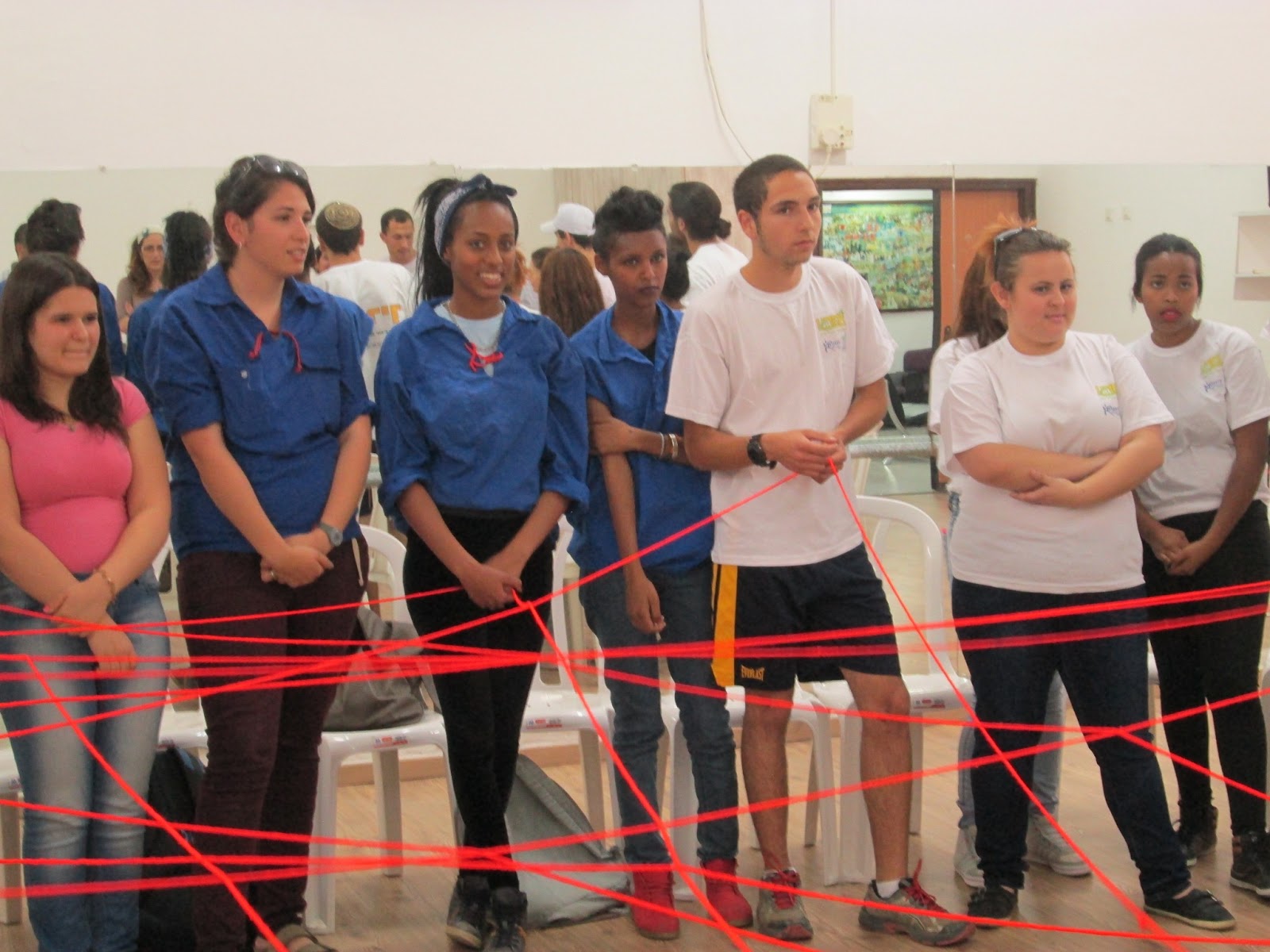
Right: networks and webs of connections in Better Together BeerSheva

Above: JDC-Ashalim Nutrition program for Ethiopian-Israeli mothers in Beersheva, Yud-Aleph neighborhood
Right: Israel Air Force/JDC "Blue Dawn" program

Tuesday, April 30, 2013

Israeli Society


I'm here in Israel with the first-ever mission of the Farash Foundation. In a packed itinerary, we’re experiencing the challenges and horizons of Israel, and the work of the Joint.

One of our most impressive meetings was an introduction to Israeli society and its challenges by Professor Jack Habib, Director of Myers-JDC-Brookdale, our foremost applied-social research institute.

Jack gave a superb overview of the challenges that Israel faces, which in some ways are even more striking than any other country:
(1)   huge immigration, per capita more than any other country
(2)   massive cultural diversity
(3)   and huge diversity in social capital, wide gaps and inequality.

From 1948, with two populations (Ashkenazi-Sephardi) widely different in their education, culture, understandings, then absorbing an immigrant population and doubling the size of the State in two years … to 1990, when 5 million Israelis absorbed a million Russian speakers in less than ten years. The challenges have been immense. But we shouldn’t forget the successes.
In 1992, at the height of immigration, unemployment in Israel was 25%
Just four years later, it had dropped to 6%.

When we invest in immigrants, we get great results.